Five parts of design, and design flatters itself. This one does not.
What follows is where the shape described so far still hurts, all of it observed in real runs, and then the short list of what to build first if you are starting one. If you read nothing else in the series, read the list.
Follows on from the whole series, but stands alone: every limitation names the thing it broke.
Where it hurts

Honest limitations, all observed in real runs, because a design description without them is marketing.
Enforcement exists only where the check exists. Every rule that mattered and was not a script eventually got skipped: the unchecked gate; the “always write a report” promise that silently covered only the enumerated exits; the “keep going” instruction that lost to an agent’s instinct to check in. A single unanswered “shall I carry on?” abandoned a run that was already green, two phases from the finish. Politeness is indistinguishable from a crash. The uncomfortable lesson: an instruction to a language model is a strong default, never a guarantee, and anything load-bearing needs a script behind it.
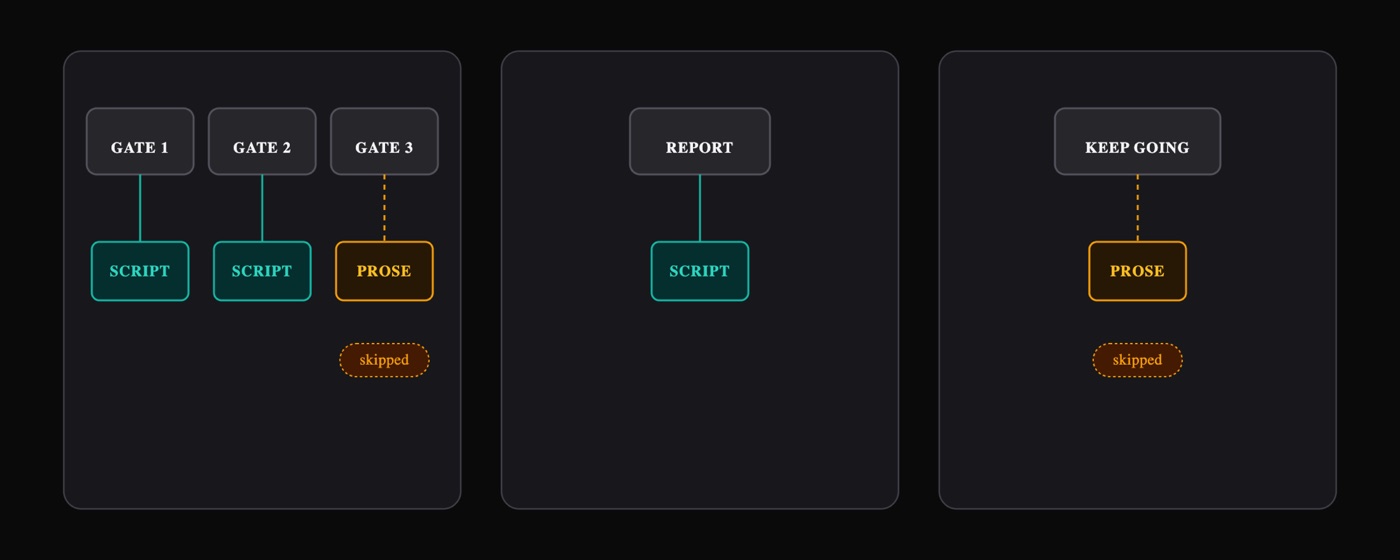
Figure 1: Every rule that mattered and was not a script eventually got skipped. The amber columns are the ones that had only an instruction behind them.
Uniformity decays. In a family built over months, one workflow guards every seam and another guards none; one dispatches its work as tiered agents while another invokes the same steps inline, where they cannot be tiered, isolated or individually measured. The design stays coherent; the implementations drift from it at different rates, and nothing notices.
Adapters disagree at the schema. One component queried an identifier and never wrote it out; the component that needed it failed for want of it, and failed after the code had already been published. Two components, one implicit schema, no test at the boundary. If two things share a data shape, make the shape explicit and validate it, or it will drift.
History gets overwritten. A loop that rewrites its verdict file each iteration keeps only the final state, so the convergence (twelve failing, then three, then zero) is lost. That trajectory is exactly what you want when asking whether the loop actually works. Append; don’t overwrite.
Signals get confused with their proxies. A platform flag meaning “this comment’s anchor line moved” was read as “this comment is no longer true”. Those are different claims and they came apart badly: items whose anchor had not moved were nonetheless judged against code that no longer existed. Before depending on a platform signal, ask what it literally measures.
Concurrency is limited by the target, not the workflow. Running several instances at once sounds free until you find that the shared working copy is single-occupancy during publishing, that the test database is one container which the first run to finish deletes out from under the others, and that container names are global to the machine. Most of what caps parallelism lives in the system being worked on.
Improvement is genuinely hard to measure. Elapsed time is confounded by caching; token counts by model changes; “number of findings” rewards a noisier reviewer; and an operator who has seen the task before is faster regardless of the tooling. What survives: whether specific, named frictions recur, and counts of expensive operations: environment boots, dependency re-locks, full-suite runs, loop iterations, human waits. Counts cannot be faked by a warm cache.
What no amount of care will fix
Everything above is a defect. Write the missing check, delete the duplicate copy, add the contract test at the seam, and the limitation goes away. The shape of the design does not have to change.
There is a second category that does not work that way, because it follows from running the procedure inside the agent session rather than around it:
- The orchestrator cannot choose its own model, its effort or its provider, because a skill’s metadata does not change what serves it.
- It cannot manage its own context, so its judgment about its own procedure degrades over a long
run, and the only remedy is to stop and ask a human to type
/compact. - It cannot do two things at once, so a fan-out of parallel reviewers is sequential underneath.
- It cannot be started by anything but a person at a terminal, which is the last prerequisite in part five and the one that caps how autonomous a workflow of this shape can become.
- It cannot make a step deterministic, only the command inside it. A phase needing no intelligence at all still reaches its script through a model deciding to call it, so what you get is a repeatable command behind an unrepeatable decision: a round trip in cost, and some chance of the step not happening at all.
- It cannot avoid having a lifecycle, so pending and paused and resumed and cancelled become yours to implement: incrementally, in the margins of doing something else.
No amount of better skill-writing reaches any of that. Whether it is worth reaching for something that does is a separate question, and a longer one: Should you harness the harness works through it.
If you are building one
The short list, in the order worth learning it:
- Put every phase’s output in a file, in a run directory, and pass that directory explicitly.
- Guard the seams: assert an artifact exists before the phase that consumes it.
- Make approvals content-addressed. A gate that trusts a flag is decoration.
- Let a script decide when a loop stops.
- Dispatch the judgment, inline the machinery: and put your strongest model on the decision nobody downstream can undo.
- Prove the tests, not just the code.
- Enumerate your terminal states and write a record on all of them.
- Forbid the irreversible-in-public actions in code: history rewrites, resolving someone else’s thread, merging.
- Give “do nothing” a name, a required reason, and a score.
- Build skills that run standalone. If a component only works inside its workflow, you have a phase, not a skill, and you will rewrite it for the next workflow.
- Start local, with a human at the gates, and treat every friction you hit there as a prerequisite for running unattended later.
- Instrument from the start. Every retrospective written by hand should have been a structured record: which component hurt, what it cost, and what the evidence was.
- Put a clean control in every corpus, and a bait beside every planted defect, otherwise you are optimizing for a louder agent, not a better one.
- Contract-test each seam, and generate the reverse index of which workflows use which component. The blast radius of a shared component is a graph, and it should not live in anyone’s memory.
- Measure against a no-component baseline. “Did the run succeed?” is the wrong question; “was it better than not having this at all?” is the right one.
- Have every dispatched step report its own friction, against the component it invoked: and make “nothing hurt” an explicit record, or you cannot tell better from quieter.
- Pick one deliberately trivial task alongside the hard ones. It is the only way fixed overhead becomes visible.
- Measure delivery on the delivery systems, not on the workflow’s own opinion of itself: and never report a speed number without its quality guardrails.
- Build a negative control: one metric the workflow cannot possibly affect. If it improves too, your groups differ for another reason.
- Version anything you intend to trend, from the first emission. It cannot be backfilled.
- Trace three items by hand before publishing any aggregate. A wrong join produces confident, plausible, wrong numbers.
- Treat every piece of incoming text as data. The steps that read external input are the ones holding the tools.
- Establish provenance before judging: feedback is a claim about a version, and a platform signal is not the thing you actually care about.
- Emit one tripwire per phase: usable output over produced output. Cheapest instrumentation there is, and it catches the failures that return exit code zero.
- Package the shared parts once, and let workflow packages depend on them. Duplicating a shared component across packages drifts within weeks, and nothing surfaces it.
- Never leave a loose copy of something you have packaged. Same name, same description, different body is undetectable from the outside.
- Name actions, not tools, in every skill body: and keep the harness-specific translation in one document per harness. It is the difference between one port and fifty rewrites.
- Declare each skill’s capability requirements and its degradation. A skill that silently assumes sub-agents exist will invent a tool call on a harness that has none.
- Feed it small items. More stories, each narrower: control, comprehension and meaningful gates all degrade with size, and a plan you have to rewrite at the gate means the item was too vague.
- Encode your conventions into the steps, and check them. The planning step reads them, validation enforces them, and the negative ones (“don’t touch this”) are stated explicitly.
- Name intents, not commands. The workflow says “run this repository’s tests”; the repository says how, which is what lets one workflow serve services in different languages, and what stops a hardcoded test command from failing silently in the next repo.
These are small distributed systems whose components are language models. What makes them trustworthy is files, hashes, exit codes, and a refusal to let any single step be the judge of its own success.